

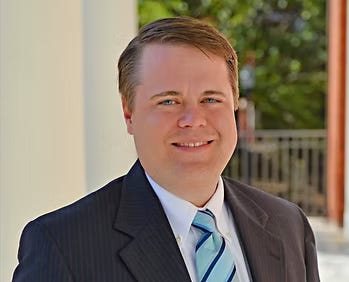
I recently sat down with Brandon Fincher, the managing editor of the Journal of Election Administration, Research, and Practice – housed at the Institute for Election Administration Research & Practice at Auburn University in collaboration with the Election Center – to talk about how he found his way into election administration research and what the journal is building for the field.
In this Q&A, we discuss his path from local journalism to election administration scholarship, what “practice” really means in the journal’s title, what makes a practitioner submission compelling, and why academic work is deeply relevant in a fast-moving professional environment. We also cover his alternate career plans involving Wheel of Fortune.
This conversation is the first in an ongoing Books & Ballots Q&A series highlighting the people shaping election administration from different angles – research, practice, policy, and everything in between.
The Journal of Election Administration, Research, and Practice is now fully open access. Anyone can read it online without creating an account or providing an email address.
The journal is available on the Election Center’s website, and all articles are free to read and share.
How did you get into election administration research? What was your path?
Like a lot of people, I didn’t start out thinking I would work in elections.
I came to Auburn for my undergraduate degree in journalism and worked in news for a while, mostly at small-town newspapers at the local level. I entered the industry right when the bottom was really falling out in the mid-2000s.
I eventually went back to school and earned an MPA from Jacksonville State University in Alabama. After that, I returned to Auburn to begin a Ph.D. program. While there, I connected with faculty members involved in election administration research, especially given Auburn’s relationship with the Election Center and the broader body of research in that area.
That experience really opened my eyes. Like many people, when I thought about elections before that, I thought primarily about the political side – campaigns and running races. I hadn’t fully appreciated the government and administrative side of elections: the many different ways they’re run, how systems operate, and the wide variation across jurisdictions.
Learning about those differences and the operational complexity of running elections captured my imagination. I ended up working closely with faculty studying election administration and ultimately wrote my dissertation in that area.
You’re the managing editor of the Journal of Election Administration, Research and Practice. As you work to grow the journal, what gap was it created to address? What’s its broader purpose?
A lot of it goes back to what we talked about earlier.
We accept articles from both the academic side and from practitioners and policy professionals. The goal is to bring those groups together. That idea isn’t unique to elections, but you often hear that academics who study a field aren’t always connected to the day-to-day realities of the people actually doing the work.
Mitchell Brown, Kathleen Hale, and the group that founded the journal wanted to help bridge that gap. I came on a bit later, but the vision was to create a space where practitioners could publish about their everyday experiences, operational challenges, and policy questions, alongside academic research.

One of the features I really like is that we invite practitioners to respond to academic papers. They can offer feedback such as, “This aligns with what I see in my office,” or “It would have been helpful to focus more on this aspect, given how it plays out in practice.”
The broader purpose is to build that bridge between research and practice and strengthen the connection between the two communities. That’s the central idea behind the journal and what we’re working to accomplish.
When you think about who reads the journal, is it the same group of people who write for it? Who is the audience you’re trying to cultivate?
Yes, it’s largely the same group.
We’re focused on people involved in elections and those interested in election policy. That includes practitioners, researchers, and policy professionals. The field is so varied that it’s easy for people to become cloistered within their own state or locality and assume that the way they run elections is the way it’s done everywhere.
One of the most eye-opening aspects for readers is seeing just how many different ways elections can be administered. That exposure can spark ideas, encourage adaptation, and create connections across jurisdictions.
Ultimately, we’re trying to grow a community. When people understand they’re not alone in the challenges they face, it strengthens the field. Building community builds resilience, generates new ideas, and helps make election administration stronger overall. That’s what we’re aiming to do with the journal.
The word “practice” is in the title of the journal. What does that mean in real terms? How does it shape what you publish and what you seek out?
We’re not overly restrictive about what we publish, but we do prioritize work that focuses on the everyday concerns practitioners face. “Practice” means we’re looking for articles grounded in what election officials actually do day to day.
From the academic side, that often includes research examining how practitioners carry out their jobs, how policies affect their work, and how administrative systems function in real-world settings. We’re especially interested in research that connects directly to operational realities rather than staying purely theoretical.
Highlighting practice is important because election officials often feel overlooked, even within their own local governments. Outside of major election cycles, their work can be out of sight and out of mind. They may receive limited funding and attention despite the complexity and responsibility of their roles.
By emphasizing practice, we aim to bring that work to the forefront, make practitioners feel seen, and strengthen the broader election community.
If I’m an election official or practitioner on the non-academic side and I’m submitting something to the journal, what makes a submission compelling? What makes you want to publish it?
One thing we appreciate is voice.
Academic writing tends to be formal and structured, and it needs to be. It’s designed to be precise and minimize ambiguity. Practitioner submissions don’t have to follow that same model. In fact, we don’t want them to feel overly formal or stiff.
We’re looking for writing that’s clear, accessible, and grounded in real experience. It can be conversational. It should sound like you. We want readers to connect with what you’ve lived and what you’ve learned. It shouldn’t feel like a slog to get through.
Some of the strongest pieces we’ve published are firsthand accounts of how election officials responded to emergency events. We’ve run several articles about how officials navigated elections in the aftermath of Hurricane Helene. Those pieces almost read like short epics. You see the obstacles they faced, the decisions they had to make on the fly, and the pressure of preparing for an election just weeks after a major disaster. Readers can relate to that and learn from it.
We also have a practitioner reflection section where officials can talk about their personal experiences and how those experiences fit into the broader election landscape.
We want submissions that are interesting and thoughtful, even when they tackle complex issues. We’re not trying to simplify the field, but you don’t need an enormous vocabulary or highly technical language to make an impact. Clear, authentic, experience-driven writing is compelling to us.
And we’re always looking for new submissions.
Election administration has changed rapidly over the last decade. Academic journals are not always seen as fast-moving or immediately responsive. How do you keep the journal relevant in a rapidly changing environment?
A lot is changing quickly in election administration. At the same time, many of the core operational elements remain relatively constant. That balance helps.
We publish articles on topics that are both timely and foundational. For example, in a previous issue we included work on ranked choice voting and how it is implemented. In the current issue, we are finalizing an academic article on social media usage in elections. These topics may respond to current developments, but they also address structural questions that do not disappear after a single news cycle.
Academic research often involves longer-term studies, but that does not mean it becomes irrelevant quickly. In many cases, the findings remain useful a year or two later because the underlying administrative questions persist.
Another factor is the diversity of election systems across states. There is always something to examine because states approach policies differently. An article can serve as an educational resource. For example, someone may want to understand how same-day voter registration works in practice. We try to publish both policy-oriented perspectives and academic analyses so readers can see the issue from multiple angles. That gives them a fuller picture of what has worked, what challenges have emerged, and what might be improved.
Ultimately, readers decide how to apply what they learn. If a policy already exists in their state, they may use the research to strengthen it. If they are considering adopting something new, the journal provides material they can reference when answering questions from legislators or local officials. Even if an article is not about something that happened yesterday, it can still offer practical value for decision-making and long-term planning.
If you weren’t working in election administration or election administration-focused research, what would you be doing instead?
I always tell people my dream job would be to take over for Vanna White when she retires from Wheel of Fortune. Hopefully that won’t be for a long time.
It just seems like a great job. You press the letter, it lights up, and you get paid – what I assume is a decent amount of money – to do it.