

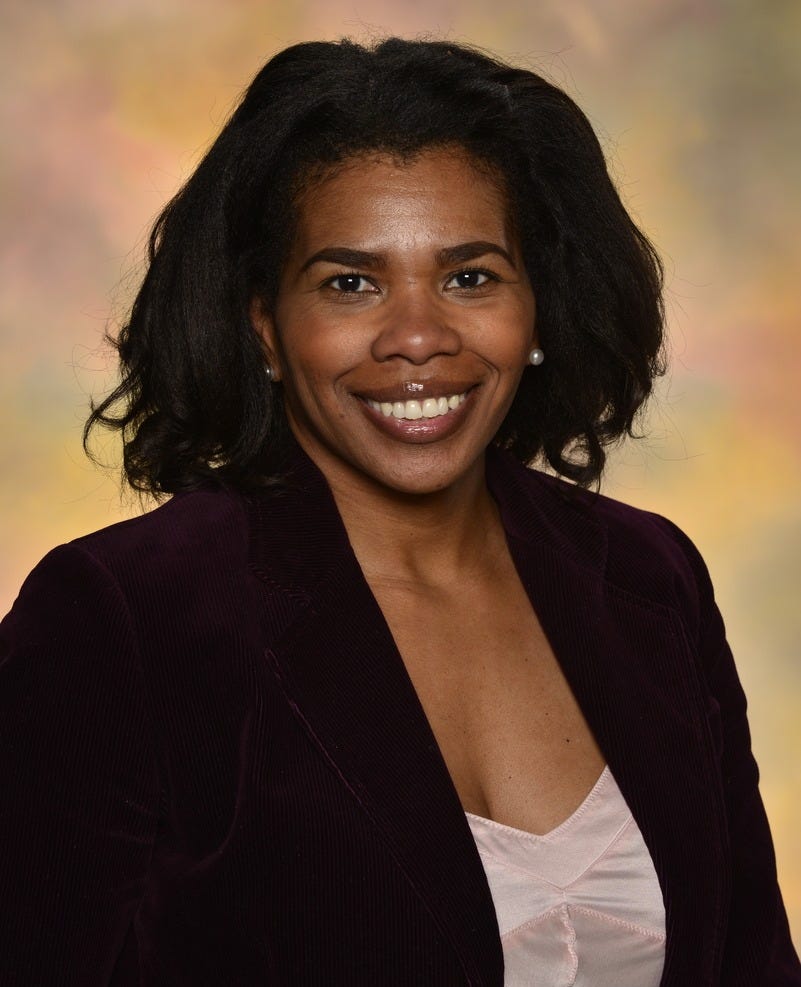
I recently sat down with Bridgett King, an associate professor of political science at the University of Kentucky, to talk about how she found her way into election administration research, what she’s learned about bridging the gap between academics and practitioners, and what question she thinks the field still hasn’t answered well enough.
In this Q&A, we discuss her path from criminal justice research to the Brennan Center for Justice to studying how voters experience the act of casting a ballot, what it actually looks like to make academic work useful to election officials, a cautionary tale about public records requests, and the leadership development project she’s currently wrapping up.
This conversation is the second in an ongoing Books & Ballots Q&A series highlighting the people shaping election administration from different angles – research, practice, policy, and everything in between.
How did you end up studying election administration as a political scientist? Was there a moment or experience that pointed you in that direction?
It was not a straight line. When I was in grad school getting my master’s degree at Kent State, I thought I wanted to be a juvenile probation officer. One of the deans encouraged me to get a PhD instead, and I was happy to prolong my adolescence, so I said yes to more school.
I was assigned to work with Caroline Tolbert, who is now at the University of Iowa, and she was doing a lot of work around voter turnout and how state policy structures participation. My background was in justice studies, so I became interested in the rules around people with felony convictions and their voting rights. Working with her was the opportunity to bridge the two. That’s when I was first introduced to the idea that formal institutions – rules – shape what participation actually looks like.
When I finished my PhD, my first job was as a voting rights researcher at the Brennan Center for Justice. If you remember the 2012 election, that was when people were waiting for hours in jurisdictions across the country, and Barack Obama made those remarks about something we have to fix. That’s when my focus shifted. I moved away from state-level legislative structures and policies toward the people in local jurisdictions who are actually on the ground facilitating what voters experience when they go to cast a ballot. And from there, toward how those individual experiences shape how people perceive the system and have confidence in it.
A lot of what you do seems oriented toward making research useful to practitioners. What have you found actually works when it comes to making academic work digestible and useful for election officials?
Part of it is just acknowledging, as an academic operating in a publish-or-perish environment, that not every research project is destined to be a peer-reviewed piece of scholarship. There’s still professional value in writing something that reads like a blog post. I know at one point the Election Sciences, Reform, and Administration conference asked presenters to write a more accessible summary of what they found and why it mattered, alongside the traditional academic presentation. Things like that matter.
There’s also working with organizations like the Bipartisan Policy Center, NCSL, and the Election Assistance Commission, which create opportunities to present on issues you care about without necessarily framing it around a research question and statistical analysis – just talking about what the scholarship says or what you’ve observed.
One of the best experiences I had was working with the YMCA of Minneapolis, the Minneapolis elections office, and CIRCLE at Tufts on a project involving student election judges. Together, we developed reports from the perspective of young people speaking to election officials, the media, and school administrators about how youth can get civically involved and what that experience is like from their point of view. That project was driven by the students themselves and the work they were already doing in the elections office. As academics, we can take a backseat, lend the methodological skills we learned in graduate school, and let other people lead the show. You do not need to put the p-value in the paragraph. If people care about that, it can go in an appendix. What matters is communicating what you learned through infographics and other tools that are actually accessible to the general public.
Academic publishing moves slowly. At the same time, election administration has moved considerably faster over the last decade. How do you reconcile those two worlds?
I’d echo what I think most people would say – that even when individual topics are moving quickly, the underlying fundamentals often aren’t. There’s something durable there even when the surface feels chaotic.
But I’d also add that there are more ways to share work now than there were before. Blog posts, practitioner-focused conferences, presentations in progress – you can get ideas in front of people before they’ve gone through the full peer review cycle.
And there’s just no substitute for actually being in relationship with the people who do the work you study. They can save you from yourself. I’ve had conversations where something that feels enormously significant to me or to the general public turns out to be a fairly minor adjustment to an office’s processes. And then there are things that look simple from the outside where someone explains the downstream effects and suddenly that’s where the whole story is. You can’t really get that from reading statutes or following the news. There’s a lot to be said for physically leaving campus, walking into an elections office, and being willing to sit there, listen, and be quiet.
Have you ever run into election officials who were skeptical of researchers? How did you handle it?
Yes, and I have a perfect example of what not to do.
Early in my time at Auburn, I became interested in provisional ballots and decided – and this is genuinely embarrassing in retrospect – to send public records requests to every election office in a state I will not name. This was before 2020, so it wasn’t even during a period of heightened public skepticism of researchers. People just didn’t know what I was asking for, some thought I was up to no good, and everyone was confused about why I wanted the information I was requesting. It did not go well.
Later, I was at an election administrator-focused conference and described what I’d been trying to do. The practitioners I talked with were very frank with me – not telling me not to pursue it, but walking me through how data enters their offices, how they code things, what the forms actually mean to the people filling them out. That was enough. I effectively abandoned the project.
I’m not a medical doctor, but I think academics whose work can end up in court cases or who serve as expert witnesses have a responsibility to do no harm. Precision matters. Words mean things. The results we publish have consequences. Even if you can get software to produce results from a dataset, that doesn’t mean those results actually communicate what you think they’re communicating. That experience was foundational for me in terms of leaning on my professional network before I go too far down a path that might cause harm.
Is there a project you’ve been especially proud of?
The one I’m currently wrapping up is the Leadership and Election Administration project. We used a cohort model – essentially creating a community of practice – to investigate the relationship between professional development, career trajectory, and retention in the field.
The important thing about it is that it wasn’t a training program. It wasn’t about bringing election officials together to tell them how to do their jobs. It was about helping them think about themselves as professionals with a wide variety of knowledge, skills, and abilities who engage in leadership activities even when those activities aren’t formally part of their job description.
We had two in-person meetings – one at the beginning and one at the end – with network exercises and panels. One panel was on leadership from any seat: even if you’re not the director of your jurisdiction, what does leadership look like for you? How do you elevate your expertise as a subject matter leader? We also held remote sessions where people from different parts of the ecosystem – nonprofits, consultancies, EAC staff, vendors – just talked about what the profession looks like beyond being a local election official. We had an international elections panel. The idea was to expose people to other opportunities, whether they want to move formally up, move from local to state, or just expand their knowledge and skills by considering things like international observation.
I’m presenting the first results at the April Election Center meeting.
What’s the question in election administration you think is most urgent and most understudied right now?
I think it connects directly to what the leadership project was trying to get at. We know from scholarship in other fields that it’s the softer connections – community, belonging, feeling part of something – that really matter for longevity, especially when the environment is difficult. But in election administration, a lot of the energy around supporting the workforce is focused on resources and job skills: here’s what you need, here’s how to do it better.
What I think we need to understand better is what it means to make professionals in this space feel genuinely connected to a community beyond their immediate office. Not just equipped to do their jobs, but supported in being part of a field. That’s not exactly understudied, but I don’t think we’ve taken it seriously enough as a retention and resilience issue. The people doing this work need both the resources and the community. One without the other isn’t enough.
If you weren’t studying elections, what would you be doing?
Honestly, I have no idea. I wanted to be a juvenile probation officer, so maybe that – though it feels unlikely at this point. I’m a child of social workers, so maybe I’d be a social worker.
I’ve very much been on a non-planned plan for most of my life, and I’m not sure what my present would look like without those pivotal encounters along the way that led me here. I don’t know that I’d have it any other way.