

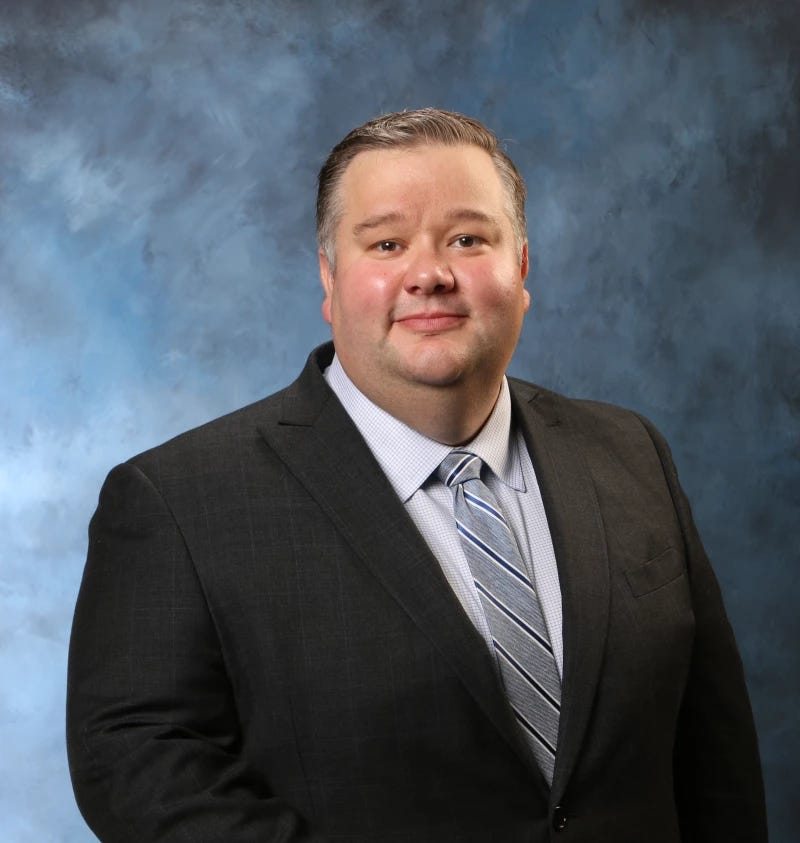
I recently sat down with Cameron Wimpy, department chair and associate professor of political science at Arkansas State University and director of the Institute for Rural Initiatives, to talk about how he found his way into election administration research, what rural election offices can teach the field, and why “rural” is harder to define than it might seem.
In this Q&A, we discuss his path from studying elections and voting in Africa to working on rural field research in the United States to becoming the first research director at the MIT Election Data and Science Lab, what he’s learned from listening to rural election administrators, why some officials may be skeptical when researchers show up, and the communication and staffing challenges facing some of the country’s smallest and most remote jurisdictions.
This conversation is part of the ongoing Books & Ballots Q&A series highlighting the people shaping election administration from different angles — research, practice, policy, and everything in between.
How did you end up studying election administration as a political scientist? Was there a moment or experience that pointed you in that direction?
It was definitely not something I set out to do. I started out studying elections and voting in Africa. Most of my doctoral work and dissertation focused on that, and I spent a lot of time doing fieldwork in African countries — monitoring elections, observing, and talking with people about their voting experiences and about life in new democracies.
After graduate school, I moved to Washington, D.C., and worked for a consulting firm, Fors Marsh. Initially, I was doing survey methodology and data science work, but I pretty quickly got moved into a large project for the Food and Drug Administration that involved fieldwork across rural America. At that same company, I also ended up working on election administration projects with the Federal Voting Assistance Program through the Department of Defense. That was really the first time I became interested in American elections. I had never set out to study them.
Later, when Charles Stewart started the MIT Election Data and Science Lab, I took a job there as the first research director. That solidified my interest in election administration. So it was not a planned path. I was never especially interested in American elections at the beginning. But through that series of experiences — fieldwork, rural research, federal voting projects, and then MIT — I became very interested in the work.
There seem to be some loose connections between your earlier work in Africa, your rural fieldwork in the United States, and your current work on election administration. Is there a through line?
Yes, there is. I grew up in the Mississippi Delta. My family farms rice and soybeans, and I grew up in a very rural, small-town environment. So I have a rural experience in my own life, and I fully appreciate the rural lived experience. When I was doing fieldwork in Africa, a lot of that work also took place in rural areas. There are obviously cities in African countries, but a large percentage of the population lives in very rural places.
When I later worked on the FDA project in rural America, someone at the company knew I had that fieldwork experience and thought there might not be that much difference between managing a large rural field project in Africa and managing one in rural America. And in many ways, that was true. You deal with internet connectivity issues. If you are doing surveys and need to load data in real time, you need hotspots, cell service, tablets, software, and backup plans. You have to think carefully about how you coordinate people who are going out into the field. Safety and logistics matter in ways that they often do not when you are working in an urban center and asking people to come to a research location.
That work also got me interested in how we measure rural America. I found that people’s perceptions of what “rural” means vary a lot. Many people I worked with had grown up on the East Coast or West Coast, and their idea of rural America was often quite different from the reality. It was not necessarily negative, but it often missed important parts of the lived experience. When I moved into election administration, I started asking similar questions: How do these things vary across the election system? Most of our elections are administered at the local level — counties, municipalities, jurisdictions — and those places are very different from one another. Implementing public policy in a very urban place is different from implementing it in a very rural one. That is where those threads came together for me: rural life, fieldwork, measurement, public administration, and election administration.
What has your experience been like learning from rural election administrators?
One of the first things I learned is that many rural election administrators are not especially plugged into the conversations that people like you and I are used to having. A co-author of mine, William McLean, and I recently published an article in the Journal of Election Administration Research & Practice based on interviews we conducted with rural election administrators in the lower Mississippi Delta region. We talked with officials across six states. We chose that area partly because we are local to it, but also because it receives relatively little attention — not only in election administration, but more broadly.
What we found was interesting. Many of the officials we spoke with were not aware that people were studying their work or even interested in it. But once they realized that researchers were interested, they were often excited. There was a sense of, “We didn’t know anyone cared about what we do.” At the same time, they are not always talking with their urban counterparts. They may talk to neighboring jurisdictions, people at state association meetings, or people in their state offices. But there is often an assumption that things are so different in urban areas that there is not much to compare.
And maybe they are very different. We need to study that more. But at least from the rural administrators’ perspective, urban jurisdictions have more staff and infrastructure, while rural jurisdictions have fewer resources but may know many of their voters personally. So there is excitement about the possibility of collaboration and learning from others, but it does not seem like there is as much of that happening as there could be.
Were there examples of rural election officials who were hesitant or skeptical about researchers coming in?
Yes, there were. And I want to be clear that this is not unique to election administration. I saw similar dynamics in the FDA project. People in rural areas are sometimes worried about what outsiders think of them. They may assume, sometimes incorrectly, that people who are more educated, wealthier, or from urban areas look down on them.
That dynamic can be present when researchers enter the picture. If you call someone in Arkansas and say you are from an Arkansas university, that probably gives you a better inroad than saying you worked with the Election Assistance Commission or used to work at MIT. Those credentials may sound impressive, but they can also be intimidating. People may worry that you are looking for something they are doing wrong or that your goal is to expose some failure.
That is usually not the intent. But from their perspective, they are managing the best they can with limited resources, trying to do the job in front of them. Having an outside researcher come in can feel like one more complication. In some places, there was a little standoffishness that took time to work through. In other cases, I am not sure we ever fully worked through it.
I grew up in places that I think of as rural-adjacent but also suburban-adjacent. There were plenty of cows around, and my mom owns a farm, but I could still get to a Starbucks in 15 minutes. That probably says something about how slippery the word “rural” can be. When you talk about rural election administration, what do you actually mean?
There are different ways to measure rural. If we are talking about election administration, I think administrative measures are probably the most useful. Those often operate at the county level. There are several federal measures that look at things like population, adjacency to a metropolitan area, and remoteness.
There are also more granular measures, and there are identity-based measures. If we are talking about rural voters, vote choice, or political identity, then rural identity may matter a lot. Someone might identify as rural because they run cattle or live outside a city, but if they can get to Starbucks or a mall in 15 minutes, their lived experience is different from someone who is an hour or more from those kinds of services.
For election administration, we were mostly looking at very small, remote counties. In many cases, the entire county had fewer than 20,000 people. In some places, especially in parts of Kentucky and Tennessee, we were looking at counties with only a few thousand people. That is quite different from a county of 130,000 people that has a city of 80,000 people with most modern amenities. Even if parts of that county feel rural, the ability to drive 10 or 15 minutes to a larger place is very different from being an hour or more away.
What are the election administration questions you think are most urgent and understudied right now?
One major issue is list maintenance. That is not my main area of expertise, and I know a lot of people are working on it, but I think it is incredibly important. It varies widely from state to state, and it connects to so many current conversations about citizenship, immigration status, voter fraud, and voter eligibility. Many of those issues are relatively minor in actual scale, but they play a large role in our politics. That can filter down and affect election administration.
For example, fear and misunderstanding could lead a state to consider major operational changes, such as requiring all hand-counted paper ballots. That would create enormous challenges for election officials, especially in places that are already understaffed and under-resourced. More broadly, I think there is a real lack of understanding among the public about how list maintenance works, how voter rolls are maintained, who is eligible to vote, and what safeguards already exist.
Within the rural election administration work I study more closely, two issues come up again and again. The first is communication. Many rural election officials worry that they cannot effectively communicate with their voters. They worry that voters do not have good information, and they are not sure how to get good information to them. They are concerned about turnout, changes in polling place locations, and how those changes affect voters. The second is staffing. In the most remote and least-resourced places, election officials are often trying to run elections with a skeleton crew. Retired people who have served as poll workers for years may no longer be able to do it. People are leaving these communities. In some cases, jurisdictions may struggle to meet state mandates or legal requirements for staffing.
That is concerning. Elections are still happening, and people are doing the best they can. But the experience for both voters and election officials may not be what it should be — and may not be what the law intends.
The two big rural challenges you name — communication and staffing — both feel easy to identify and very hard to solve. Are there promising solutions, or is the first step just understanding the problem better?
No, and that is part of what makes them so difficult. When I talk about communication challenges, people often ask how to fix them. I do not know that I have the expertise to solve that. What I am trying to do is better understand the problem.
For example, I am working on a study that uses a large database of newspaper closures over time and looks at possible effects on turnout, voter confidence, and related outcomes. That is a way to test, empirically, something rural election officials keep telling me: that losing local information infrastructure matters.
But rolling out a major communications platform that reaches everyone across states and jurisdictions is not easy. Staffing is not easy either. You cannot simply move people into these places and tell them to do what is essentially volunteer election work. If current trends continue, these problems are likely to get worse. The first step is understanding what the trends really are and what we can say with confidence, as opposed to what we hear anecdotally when we are out talking with people. The longer-term challenge is getting the right people together to think seriously about how to address them.
Last question: If you weren’t studying elections, what would you be doing?
If I were still a political scientist, I would probably be working primarily on political methodology — how we estimate models of politics, what tools are available to us, how we can improve them, and how we can make interpretation better.
I have spent a lot of time thinking about how to make those tools more accessible to researchers. There is often a disconnect between theoretical ideas and what people can actually put into practice. Whether I would still be doing work in Africa is a different question. That kind of work becomes harder when you get married, have a family, and end up in a job that requires you to be in one place every day.
But if I were not a political scientist at all, I think I would almost certainly be doing something related to agriculture.